
Distortion-Free Sensor with a Rotating Magnetic Field
Rapidly modulating core signals creates a rotating field that guarantees consistent phase and amplitude wherever the flaw passes.
The flow of eddy currents induced by the primary field must be observed carefully. When a surface crack suddenly interrupts and distorts the flow, it is recognized as a defect — but bruises or magnetism in the conductor can also distort the flow and be mistaken for defects.
Magnetism is not a defect, so its signal must be separated — which requires the magnetic signal to have a consistent phase direction. A signal with consistent phase can be cleanly removed by a phase-separation gate, and that requires a distortion-free sensor.
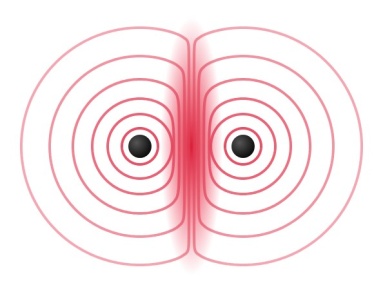
In the widely used differential sensor, eddy currents overlap between the two cores and the signal is heavily distorted. Flaws passing through the overlap differ greatly in phase from those passing elsewhere, and signals may cancel out, producing a smaller flaw signal.
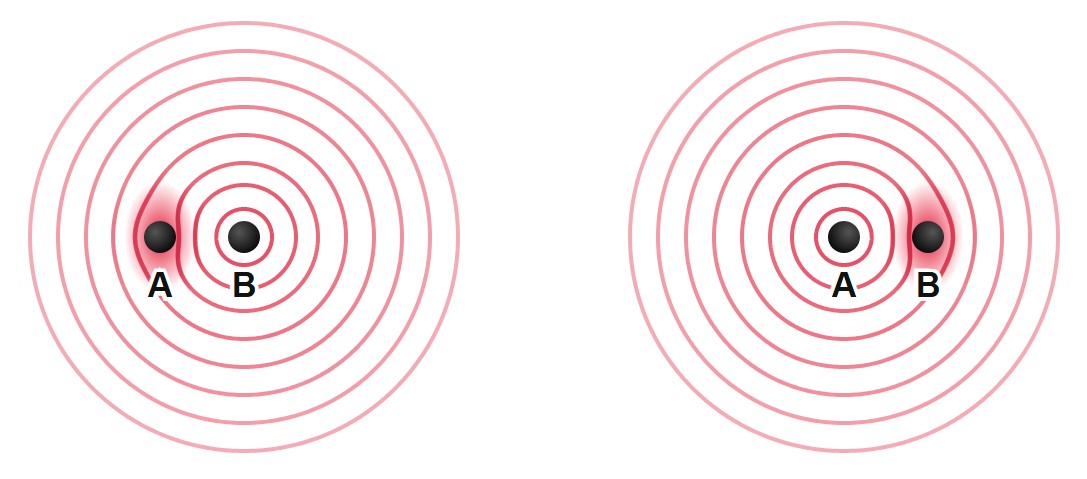
Rapidly modulating the signal strength of cores A and B minimizes distortion. The alternating signals appear to rotate, guaranteeing consistent phase and amplitude for flaws passing around the cores. With four cores, the field rotates even more distinctly.
Looking for the right eddy current solution for your line?
From sample tests and custom probe design to installation, our engineers are with you.